
New Scams … Literary Agent Impersonators!
With the permission of Victoria Strauss and the Writer Beware® blog, I’m re-printing a recent blog and warning that Victoria put out about the continuing Scams that many of you are getting hit by within not only Texts, but your emails. With the increased AI presence, the overwhelm to you, your email, and your texts is mind-boggling. Please, PLEASE … do not get duped by these thieves. What’s at risk: how about your books, your ideas, your literary, your literary presence.
Writer Beware® is the official blog created by visionary Victoria that shines a bright light into the dark corners of the shadow-world of literary scams, schemes, and pitfalls. Also providing advice for writers, industry news, and commentary. Writer Beware® is sponsored by the Science Fiction and Fantasy Writers Association. If you aren’t subscribing to, start now: https://writerbeware.blog/ .
Remember if it sounds just too good to be true it isn’t…

 EDITING SCAMS
Two New Impersonation Scams to Watch For POSTED BY VICTORIA-STRAUSS FOR WRITER BEWARE® ON JANUARY 30, 2026
Impersonation scams in publishing tend to be variations on a theme, since the goal is always the same: to sell you something. In that sense, the scams below, which are aimed at tricking writers into paying for editing, don’t break new ground. Still, the approaches are distinctive, and I’ve seen enough examples at this point to be sure they are A Thing (as opposed to isolated occurrences), so I’m highlighting them here.
As you’ll see, they appear to be yet another variant of the AI-driven scams from Nigeria. One of the characteristics of such scams–along with Gmail addresses and effusive fake personalization–is how closely each variant sticks to a specific M.O, customizing the approach to the targeted writer but otherwise pulling from the same playbook.
For tips on vetting an independent editor, see the Editors and Editing Services page of the Writer Beware website.
A Random Person Invites You to Contact a Literary Agent
This email was passed on to me by the impersonated agent, who found out about the scam because multiple writers reached out to her to check on it. I think the flood of AI scams has made writers warier than usual–so it’s not surprising that a contact like this, from a random individual who doesn’t bother to say how they a) encountered the writer’s work, or b) got hold of the writer’s email address, rings pretty loud warning bells.
The “direct” address for the agent is, of course, fake and controlled by the scammer. (The agent has posted a warning.)
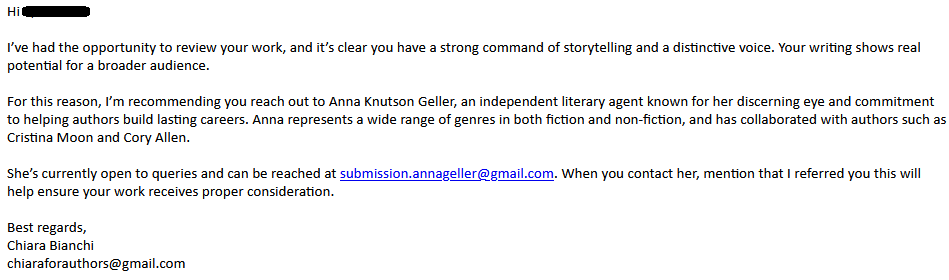
Here’s another example, from random person Chiara Bianchi, with another fake submission email address.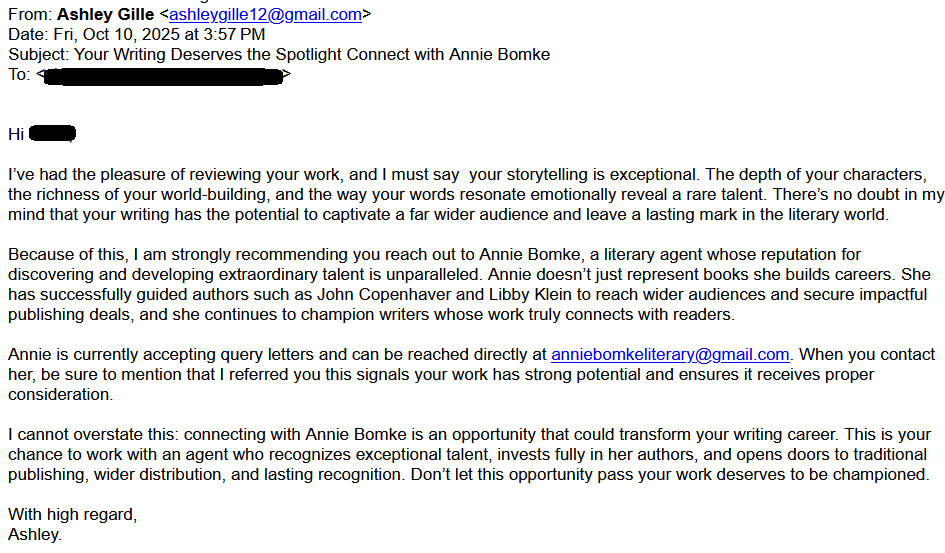
Although it’s shorter and less effusive than the first example, notice how similar it is, with the same structure to the first three paragraphs. “Ashley Gille” and “Chiara Bianchi” may well be names controlled by the same scammer. And guess where “Chiara” is posting from? (I do love Xitter’s new account location feature.)


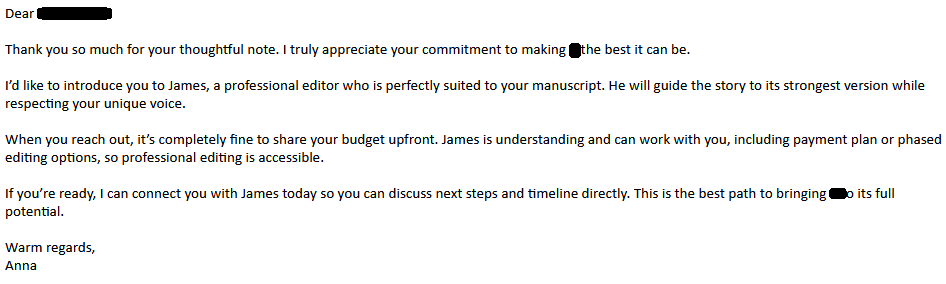
A writer who used the fake submission address provided by Chiara received–surprise!–a referral from the impersonated agent to James, a “professional editor” with no last name or website. (Pro tip: a real editor with a real editing business will have some form of web presence.)
A Retired Agent Wants to Recommend You to an Active Agent
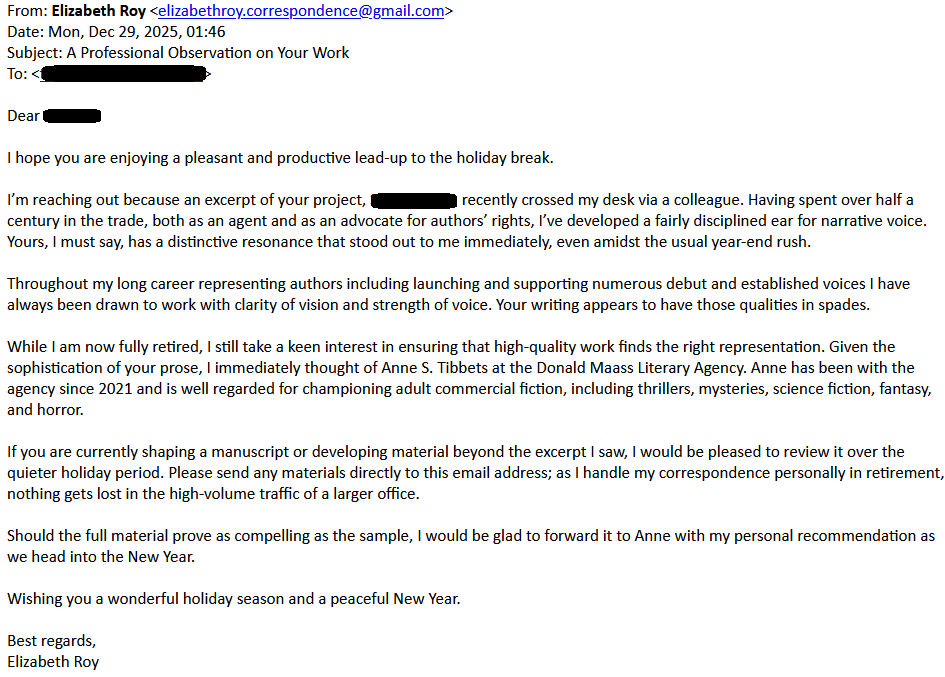
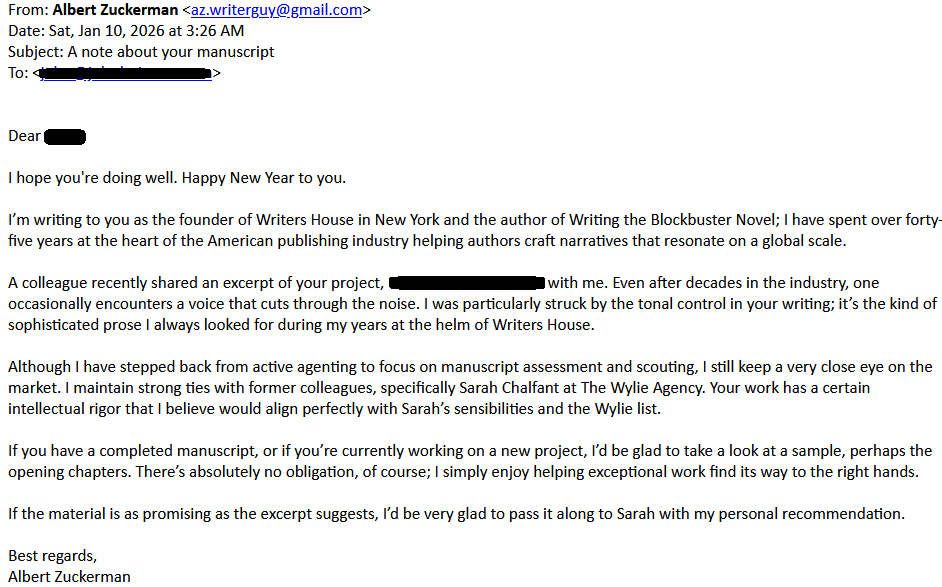
Here, the scammer impersonates a retired agent, or an agent who has stepped back from active agenting but keeps a keen eye on the industry. This person has encountered your excellent work in some vague and non-specific manner and is eager to recommend you to a different agent who’d be a perfect match.
Below are three examples of these flattering solicitations, each impersonating a different eminent publishing professional. Examples 2 and 3, which are basically identical, certainly come from the same scammer, but example 1 is similar enough in structure that I’m betting it does as well. (Note the AI oops in example 3.)
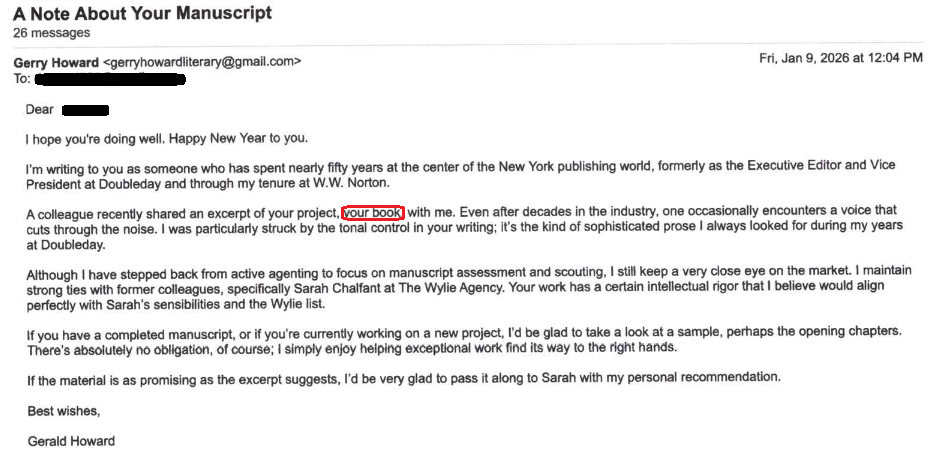
The writer who received example 3 sent their manuscript to “Gerry”, who purported to be very excited about receiving it, and waxed enthusiastic about its international potential. But–oh dear–there were some lapses and inconsistencies. Had the author ever considered an editorial review? Perhaps by a professional Narrative Architect? (Note: “narrative architect” is not a term of art, in publishing or anywhere else.) If the writer didn’t have any Narrative Architects in their literary circles, Gerry would be happy to suggest one.
This is a classic scam technique for easing into a referral: identifying a problem, describing how it can be fixed and by whom, and offering to provide a recommendation if the writer doesn’t know anyone like that. Of course the bet is that the writer doesn’t know anyone like that, and will be glad of a referral, which now seems like the writer’s own idea: an illusion of optionality intended to obscure the fact that the referral is the entire point of the interchange.
Gerry’s Narrative Architect turned out to be Morgan Hart, a dude with no web presence and a suspicious email address. In the email below, Gerry is careful to dangle the carrot (Sarah Chalfant, Wylie) along with a small stick in the form of “time’s a-wasting” buying pressure.
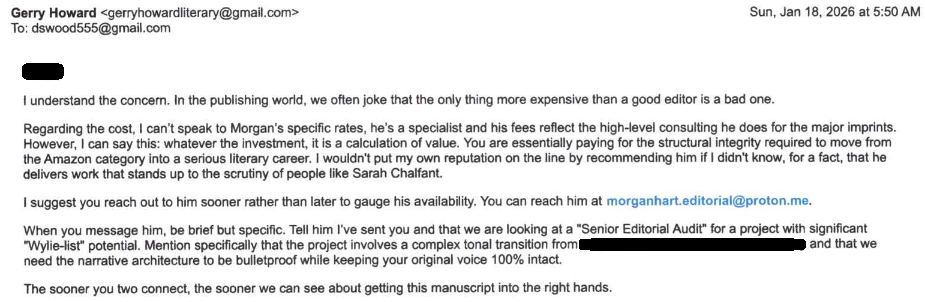
The writer did contact Morgan, who was happy to oblige and, in an email full of silly jargon no real editor would use, proposed a Senior Editorial Audit (also not a term of art) for a fee of $2,400, the full amount to be paid upfront (another pro tip: even in non-scam circumstances, don’t ever pay the full amount upfront). The scam ran aground on Morgan’s incredibly unprofessional engagement letter, which despite fancy formatting and an official-looking yellow background bears no resemblance to an agreement a real editor would provide, and rang warning bells the writer couldn’t ignore.
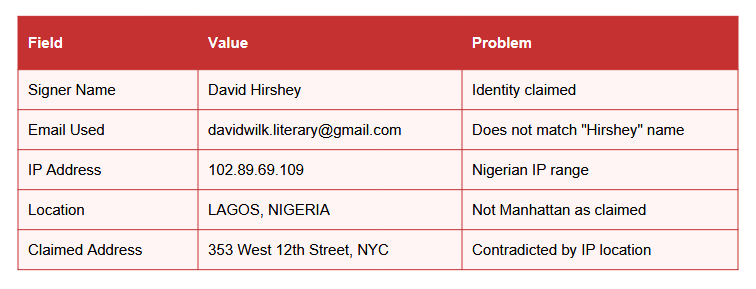
When the writer brought up their concerns, the scammer pivoted, recommending a new editor, David Hirshey of Hirshey Editorial Advisory (yet another impersonation: David Hirshey is a former Executive Editor for HarperCollins) and providing a new editorial agreement. This time, the scammer used PandaDoc for the agreement, signing it remotely…but, oops: they failed to conceal their IP address.
Swimming in an Ocean of Writing Scams
Scams aimed at writers are absolutely everywhere right now. If you’ve published a book–or even if you’re just getting ready to–they cannot be avoided. In more than 25 years with Writer Beware, it’s the worst I’ve ever seen (thanks, internet and generative AI).
I often hear from writers who despair of protecting themselves. In an ocean of scams, how can they separate the legit offers from the fraudulent ones? Honestly (and I know I’m a broken record on this), the answer is simple: you really don’t have to. Reputable individuals and companies simply don’t drum up business via direct solicitation. For scammers, on the other hand, it’s the main way they recruit clients. You will not go wrong if your default assumption is that any offer arriving out of the blue is fraudulent.
And before you chime in to remind me that agents do occasionally reach out to authors they don’t represent, and overseas publishing houses scouting for translation rights do sometimes contact indie authors…I know. But truly, the chances the email you just received will turn out to be something like that are miniscule. Does it look a bit more professional, or somewhat less scammy, than usual? You can always vet it: by verifying email addresses, for example (there are more tips on my Impersonation List). Or contacting me. What’s important is that you never, ever take an out-of-the-blue offer at face value.
It sucks that writers have to be so scam-aware–and that was true even before the current deluge of stupid AI-generated scam emails from this new breed of AI scammers who just won’t leave us alone (hence my many posts about them). But as I’ve said before, the purpose of scam awareness isn’t to portray the writing profession as a dark and dismal forest where we must fight our way through tangled schemes and predators lurk behind every tree.
It’s to build the tools and knowledge we need to identify and de-fang the predators, so we can traverse the wilds unscathed. And that, ultimately, is empowering.

Dr. Judith Briles is the award-winning and bestselling author of 48 books and calls Colorado home. When she’s not in the kitchen or in the garden, she’s working with clients as The Book Shepherd, a book and publishing consulting and project management firm that works with authors at all stages of their book to create and publish a book they never regret! She’s the founder of the first Authors’ Hall of Fame exclusively dedicated to ensuring the legacy of authors connected in some way with Colorado.
Judith’s books have been translated into 17 countries with over 1,000,000 copies sold! They have been featured in over 2,000 radio and TV shows including repeat appearances on CNN, CNBC, and Oprah. She has worked with over 1,500 authors and created 500 plus bestsellers. Print publications include Newsweek, People, Time, The Wall Street Journal and … The National Enquirer! Her popular podcast, AuthorU-Your Guide to Book Publishing is dedicated to authors and writers and their success and is ranked in the top ten in four categories on GoodPods.
©2026 Judith Briles – The Book Shepherd™ All Rights Reserved.